
 Image 1 of 1
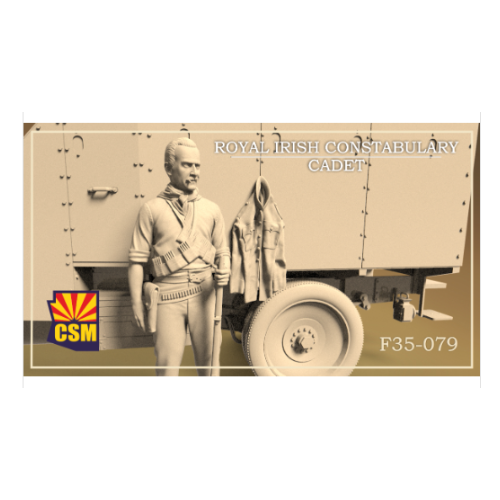
A Royal Irish Constabulary (RIC) Cadet was an officer, as opposed to a constable, within the RIC, who joined the force through a cadetship rather than enlisting as a rank-and-file constable. While the term "cadet" could refer to individuals joining the force to become officers, the term was also used, sometimes as "Temporary Cadet" or in conjunction with the Auxiliary Division, for individuals who joined the RIC for a limited or specific period, such as during the Irish War of Independence.
During the Irish War of Independence, the RIC faced mass public boycotts and attacks by the Irish Republican Army (IRA). It was reinforced with recruits from Britain—the Black and Tans and Auxiliaries—who became notorious for police brutality and attacks on civilians. The Ulster Special Constabulary (USC) was formed to reinforce the RIC in most of the northern province of Ulster.
A Royal Irish Constabulary (RIC) Cadet was an officer, as opposed to a constable, within the RIC, who joined the force through a cadetship rather than enlisting as a rank-and-file constable. While the term "cadet" could refer to individuals joining the force to become officers, the term was also used, sometimes as "Temporary Cadet" or in conjunction with the Auxiliary Division, for individuals who joined the RIC for a limited or specific period, such as during the Irish War of Independence.
During the Irish War of Independence, the RIC faced mass public boycotts and attacks by the Irish Republican Army (IRA). It was reinforced with recruits from Britain—the Black and Tans and Auxiliaries—who became notorious for police brutality and attacks on civilians. The Ulster Special Constabulary (USC) was formed to reinforce the RIC in most of the northern province of Ulster.